

Activity Logs for Bookings
The Activity tab in each booking provides a complete timeline of events and notes, helping teams keep track of conversations, updates, and system changes in one central place.

Overview
The Activity tab in each booking creates a chronological record of all booking-related events and team notes. This centralized log enables teams to monitor conversations, updates, and automated system changes throughout a booking's lifecycle.
Purpose
Activity Logs serve these key functions:
- Centralize updates - All booking events and team notes are recorded in one timeline
- Clarify context - Manual notes are clearly distinguished from automated system updates
- Preserve history - Every change is stored for future reference, reducing the need to search external tools or messages
What Appears in the Activity Log
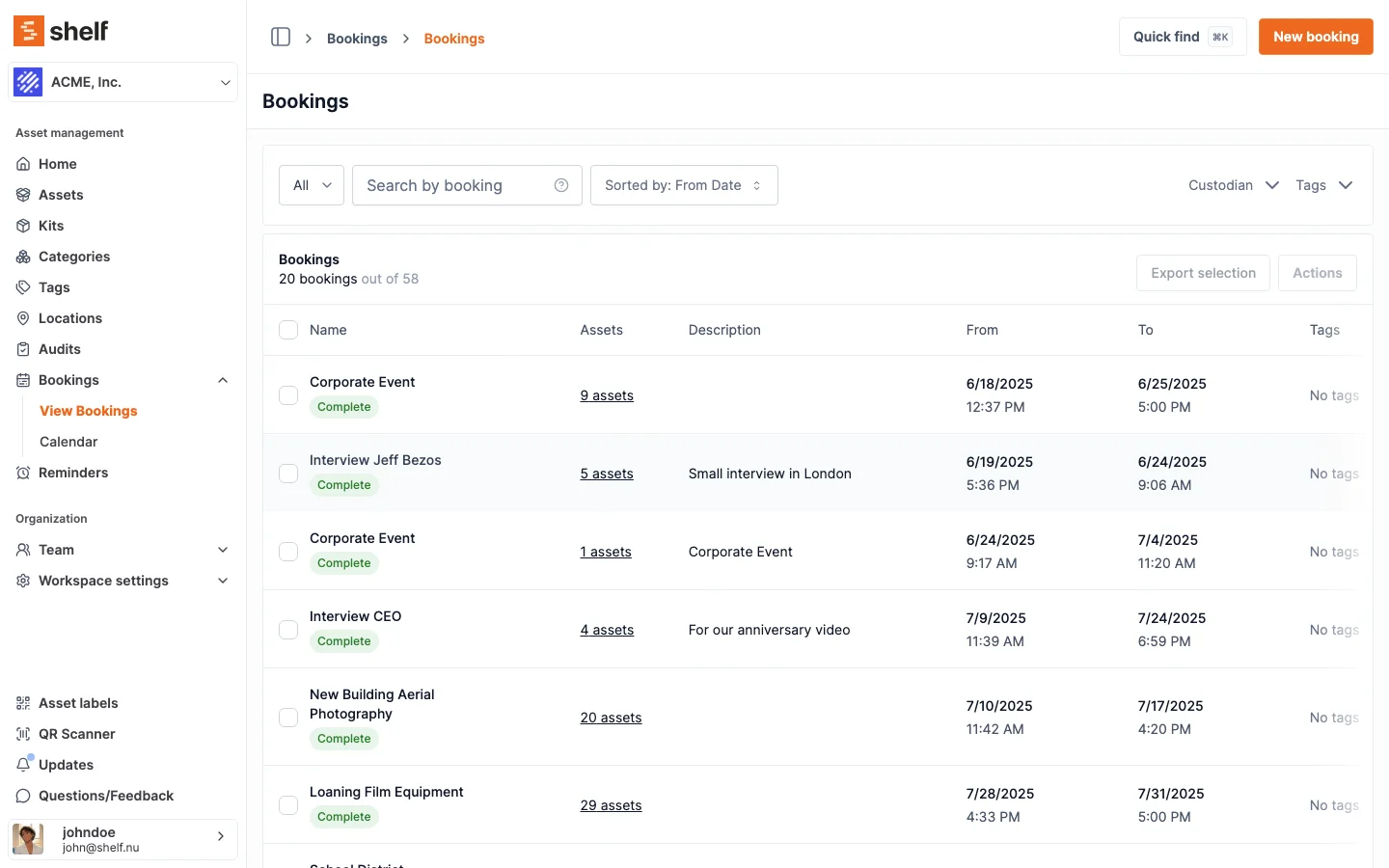
System Updates
Shelf automatically records major booking events, including:
- Status changes, naming the badge the booking moved from and the badge it moved to. The statuses are the ones you see on the booking itself: Draft, Reserved, Ongoing, Overdue, Complete, Cancelled and Archived. Some transitions say what happened in words as well, so a booking that ran past its end date reads "Booking became overdue" and one archived by Shelf reads "Booking was automatically archived"
- Field edits, one entry per field that moved, each naming the old value and the new one: name, description, start date, end date, custodian and tags
- Assets and kits added or removed, with a link to each one and the quantity where the asset is quantity-tracked
- Model-level reservations created, resized, cancelled and settled (see below)
- Check-outs and check-ins, partial and complete, naming what each one covered
- Quantity dispositions recorded at check-in for quantity-tracked assets
Team Notes
Users can add their own entries:
- Compose notes in Markdown with live previews
- Edit or remove your own notes at any time
- Clear attribution shows who added the note and when
Model-Level Reservations
Reserving a number of units of an asset model rather than a named asset leaves its own trail, and the trail follows the quantity rather than just the fact that something changed:
- Creating one reads "reserved 3 × Sony A7 III for this booking."
- Changing the number reads "increased the Sony A7 III reservation from 2 to 5.", or decreased the same way
- Cancelling reads "cancelled the 3 × Sony A7 III reservation for this booking.", so the entry that removes the commitment states the same count as the one that made it
- Each unit that gets assigned to the reservation, by scanning a specific one of them in, reads "assigned Sony A7 III #0042 (Sony A7 III) to this booking — 2 × Sony A7 III remaining.", with the asset named as a link. One entry per unit, so a promise of three can always be traced back to the three assets that filled it
Formatting and Readability
Activity Logs use Markdoc components to enhance readability. Features include:
- Localized timestamps
- Status badges
- Asset and kit popovers
- Expandable descriptions
- Consistent deep links to related records
Technical Details
Activity Logs are powered by the BookingNote data model and lightweight asset/kit APIs. This ensures the feed performs efficiently, remains scoped to each organization, and scales reliably with usage.
Example Use Cases
- Tracking which assets were returned during a Partial Check-in
- Reviewing when a booking's schedule or description was updated
- Keeping a record of team communication tied directly to the booking
- Auditing asset movements across the booking lifecycle
How to Access
Open any booking in Shelf and select the Activity tab. All system updates and team notes appear in chronological order.
Related Articles
Ready to try Shelf?
Put what you're learning into practice. Free plan available — no credit card required.