

Early Check-in and Check-out of Bookings
Shelf lets you check assets in or out earlier than scheduled, and keeps the period that was originally agreed alongside the one the booking really ran, so reporting still measures against the plan.

How Early Check-in/Check-out Works
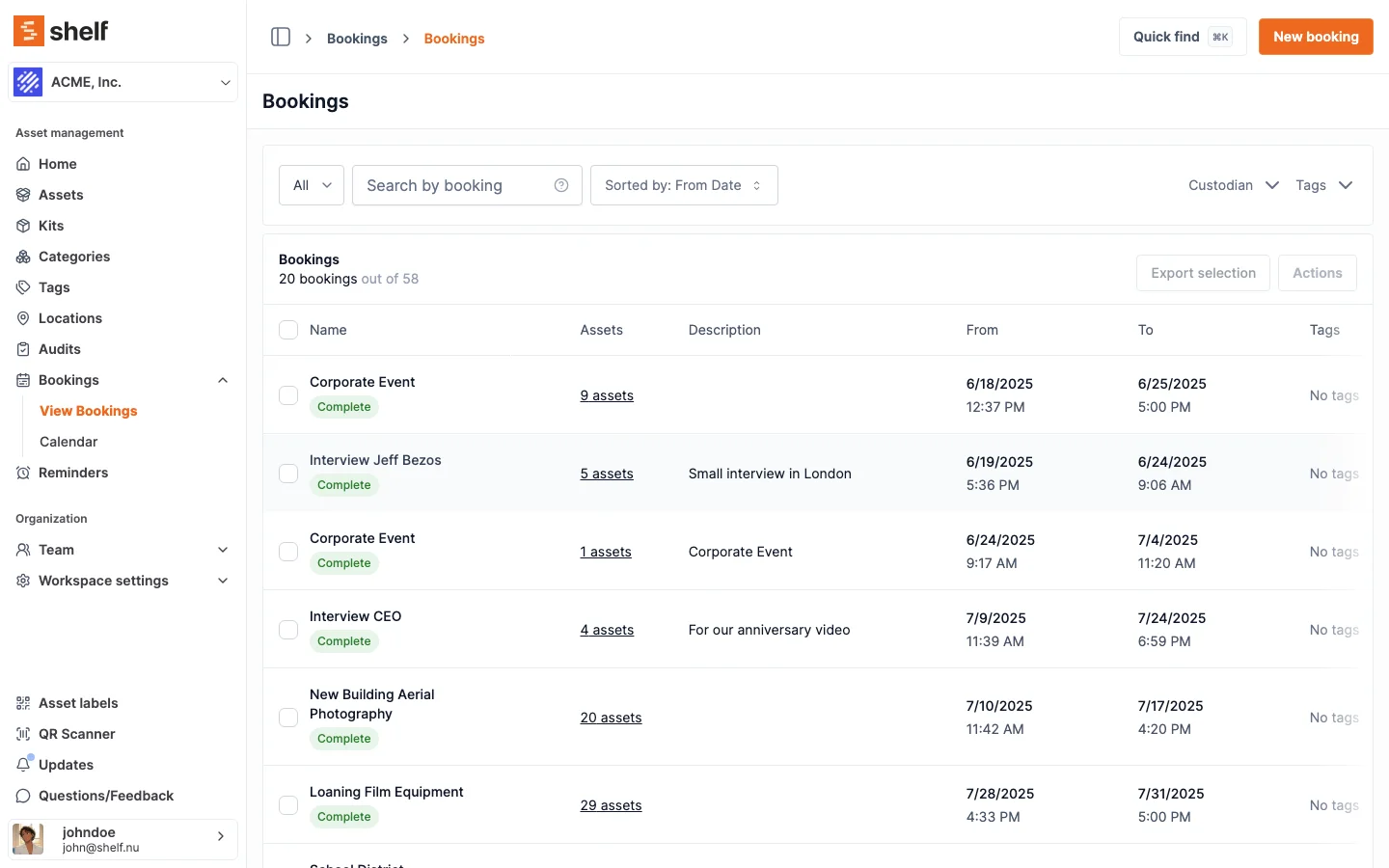
Early Check-out
When checking out assets before the scheduled start date:
- A warning message appears notifying you that the booking start date will be adjusted to the current time
- You can choose to:
- Cancel the action
- Adjust the date (updating the booking start date to now)
- Proceed without adjusting dates
Quick Check-out Asks First
Since 22 October 2026 the Check out button on a booking, and Check out remaining on one that is already Ongoing or Overdue, never check out in one click. When the check-out is on time, they open a Check out booking dialog that names the booking: "This checks out every asset of Studio Shoot and starts the booking.", or for the rest of a booking "This checks out the remaining assets of Studio Shoot." Check out goes ahead; Cancel leaves the booking as it is. An early check-out opens the warning above instead, so you are asked once, not twice. Units still to assign and the From location question for pooled stock keep their own sections. Flows that already end in a confirmation of their own, Check out selected items, Scan to check out and Fulfil reservations & check out, do not add this dialog.
Quick Check-in Asks First
Since 19 October 2026 Quick check-in, the whole-booking return in the Check-in menu, opens a Check in booking dialog before anything is returned. It names the booking and says what will happen: "This checks in every asset of Studio Shoot and completes the booking." Check in completes the booking; Cancel leaves it as it is. A partial check-in, from Check in selected items or the scanner, already confirms the items you picked, and only adds this dialog, naming N assets, when it checks in the last items more than 15 minutes before the end date.
Early Check-in
When checking in assets more than 15 minutes before the scheduled end date, the same dialog adds the early-return question:
- It says the end date can be moved to now, and that Don't Adjust Date keeps the original end date
- Options include:
- Cancel
- Adjust Date (updating the booking end date to now)
- Don't Adjust Date (keep the original end date)
If the current time is still before the booking's start date, the end date cannot be moved to a time before the start, so the dialog says so and checks the booking in without changing its dates.
Checking Out After the Reserved Period Has Ended
A Reserved booking whose end date has passed reads Expired on its chip (see Introduction to Bookings). The check-out asks first, under the heading Reservation dates have passed: "This booking's reserved period ended on 7 Oct 2026, 16:00. Check it out with a new end date, starting now, or check it out as overdue."
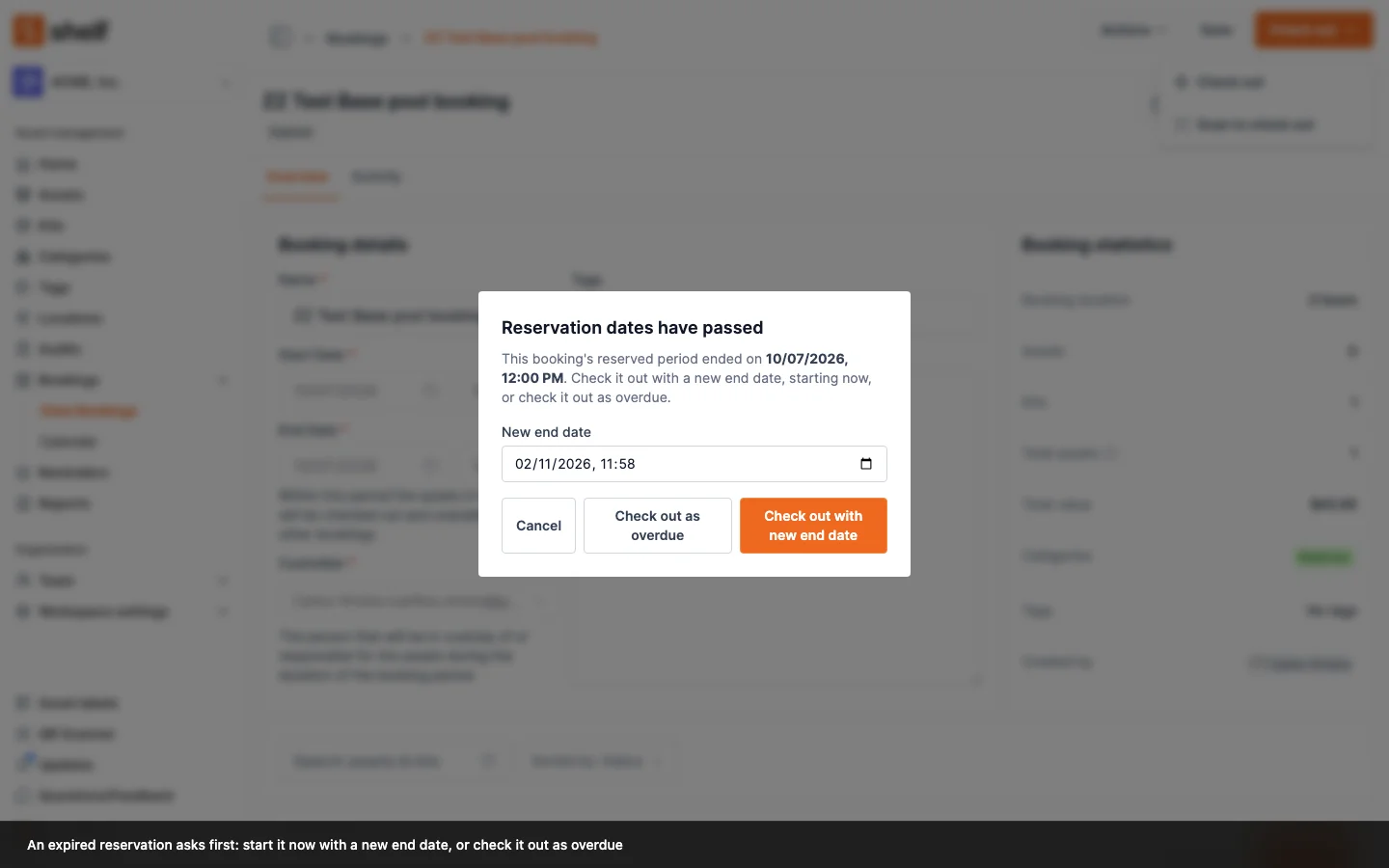
- Check out with new end date. The dialog proposes an end date, now plus the length the booking was planned for, in your own time zone; change it if you like. The booking's period moves to start now and end then, it lands Ongoing, and its check-in reminder is scheduled against the new end. The new end has to pass the rules an extension passes, your workspace's working hours and its maximum booking length measured from now, and the items have to be free for the new period: a clash with another booking, a kit held elsewhere or a short model pool is refused with the usual message.
- Check out as overdue. The dates stay as they were and the booking lands Overdue.
- Cancel leaves the booking as it is.
A new end date becomes the booking's planned period, so reports and the check-in receipt measure the return against it. The old dates stay on the booking's Activity tab.
Only Check out in the booking header offers a new end date. Scan to check out, Fulfil reservations & check out, Actions → Check out selected items and the row buttons on the Bookings list check an expired reservation out as overdue. On the Shelf Companion app, Check Out All Assets keeps the dates and lands the booking in Overdue.
An expired reservation does not have to be checked out at all. It has stopped counting against the gear, and it can be archived by hand or by the Auto-archive reserved bookings after their end date setting, or cancelled.
The Planned Period and the Actual Period
Every booking carries two periods, and adjusting the dates at check-out or check-in never overwrites the first one.
| What it holds | When it is written | |
|---|---|---|
| Planned period | The dates that were agreed | Creating the booking, and editing it while it is still a draft. Fixed once it is reserved, with one exception: checking out an expired reservation with a new end date replaces it |
| Actual period | The dates the booking really ran | Extending the booking, checking in a booking that is Overdue, and the date adjustments offered at early check-out and early check-in |
The planned period is frozen from the moment the booking is reserved. Nothing that happens afterwards moves it: not an early check-in, not an early check-out, and not an extension. The one exception is a reservation whose dates passed before pickup and that is checked out with a new end date: that new period becomes the plan, and the old one is kept on the booking's activity.
One path onto the actual end date is not a choice anyone makes. Checking in a booking that is already Overdue always moves its end date to the moment it came back, with no dialog and no option to decline, because the booking has to record when the gear actually returned. That is the ordinary way an actual end date comes to differ from a planned one, and it is why the Booking Compliance report reads the planned end rather than the live one. The early check-out and early check-in adjustments below are the ones you are asked about.
Where to Read Both Periods
- The booking CSV export carries four date columns: Planned start date, Planned end date, Actual start date and Actual end date. See exporting booking information.
- The booking's PDF overview adds an Original period row underneath the booking period, and only when the two differ.
The booking page itself shows the actual period. If you need the agreed dates alongside it, use the PDF overview or the CSV export.
Important Notes
- While a booking is still a draft, editing its dates moves both periods together. The planned period only becomes fixed once the booking is reserved.
- Scheduled reminders and overdue notifications follow the actual dates, not the planned ones. Adjust the end date at check-in and the reminders follow it.
- The Booking Compliance report measures returns against the planned end date, so an early return is on time and a booking extended past its deadline is still recorded as a late return. Overdue Items uses the actual end date, because it answers what is late right now.
Use Cases
This feature helps when:
- Equipment is no longer needed for the full originally scheduled period
- Equipment must be returned early for urgent requests
- Tracking actual versus planned usage for reporting and analytics
The ability to track both original and adjusted periods provides transparency for resource planning and utilization analysis.
Ready to try Shelf?
Put what you're learning into practice. Free plan available — no credit card required.