


Case Study
Industrial Artifacts / Rock Auction Gallery
Room 4, Bay 7, Bin 36
How an online antique mall in DeKalb, Illinois keeps ten thousand one-of-a-kind objects findable across two buildings, and pulls four hundred auction lots off the floor every month.

- Business
- Online antique mall with a sister auction house, Rock Auction Gallery
- What they track
- 10,000+ one-of-a-kind objects — furniture, signage, salesman samples, architectural salvage
- Where
- Two buildings: six rooms of bays plus ~50 rolling tables, each one a location in Shelf
- Who is in Shelf
- 10 people every week — catalogers, shipping, auction fulfillment, warehousing
- Sells through
- Own Shopify storefront, Etsy, eBay, Chairish, 1stDibs, and their own monthly auction
- The switch
- 8,860 items off Sortly in under two weeks, keeping the barcodes already on the shelves
“Only lamps go here”
Al Ferris can tell you exactly how an inventory system dies.
“Much like Industrial Artifacts circa 2016, you too can say to yourself ‘This is my bay for lamps. Only lamps go here.’, but the moment your employee moves one to rewire it, gets pulled from that job, then goes home for the day and forgets where they put the lamp, your system is ruined. This happened to us over and over and over again.”
That is the whole problem in four sentences, and it is the reason most warehouses run on memory long after memory has stopped working. There is nothing wrong with the rule. There is something wrong with expecting a rule to survive contact with a Tuesday.
Ten years on, Industrial Artifacts holds more than ten thousand objects across two buildings, and no two of them are alike.
“To this day, I am still pleased when I go to 231, Room 4, Bay 7, Bin 36 and I’m able to find a 6 inch collectible ‘whatever’ exactly where Shelf said it was going to be.”
— Al Ferris
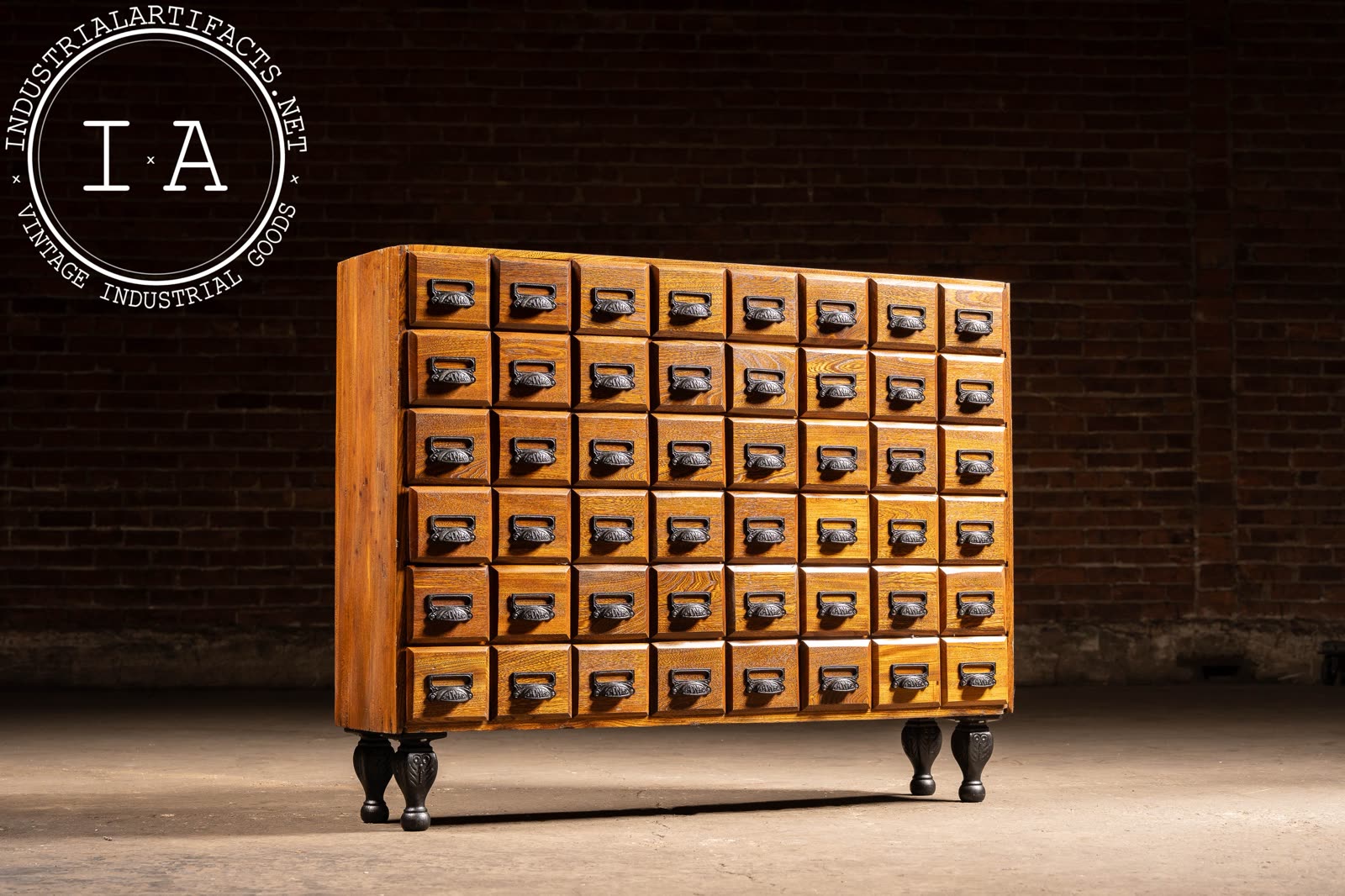
Forty-eight drawers, and a label on every one. The building works the same way: rooms, bays, bins and rolling tables are all locations, and every object sits in exactly one of them. — Industrial Artifacts
At a glance
- More than 10,000 one-of-a-kind items tracked across two buildings
- Six rooms, each with banks of bays, plus roughly fifty rolling tables that are themselves locations
- 360 to 400 lots pulled, invoiced and scanned into Sold at every auction close, monthly
- Up to 800 lots when two auctions run back to back
- 10 team members in the system every week, most of them nearly every day
- 8,860 items migrated off Sortly in under two weeks, keeping the barcodes already on the shelves
A patent model, a taxidermy bear, and a pair of demon statues
Industrial Artifacts is an online antique mall in DeKalb, Illinois, about sixty miles west of Chicago. They sell through their own Shopify storefront, Etsy, eBay, Chairish and 1stDibs, and they run their own auction house, Rock Auction Gallery, as a sister company.
Al describes the stock better than any summary could.
“Our warehouse is filled with thousands of pieces ranging from collectible smoking pipes to massive general store cabinets and installation pieces. Our specialty is in antique cabinetry and statement pieces, whether that’s a patent model of the first gas pump, a taxidermy brown bear, or a pair of demon statues from a Black Sabbath stage set.”
— Al Ferris
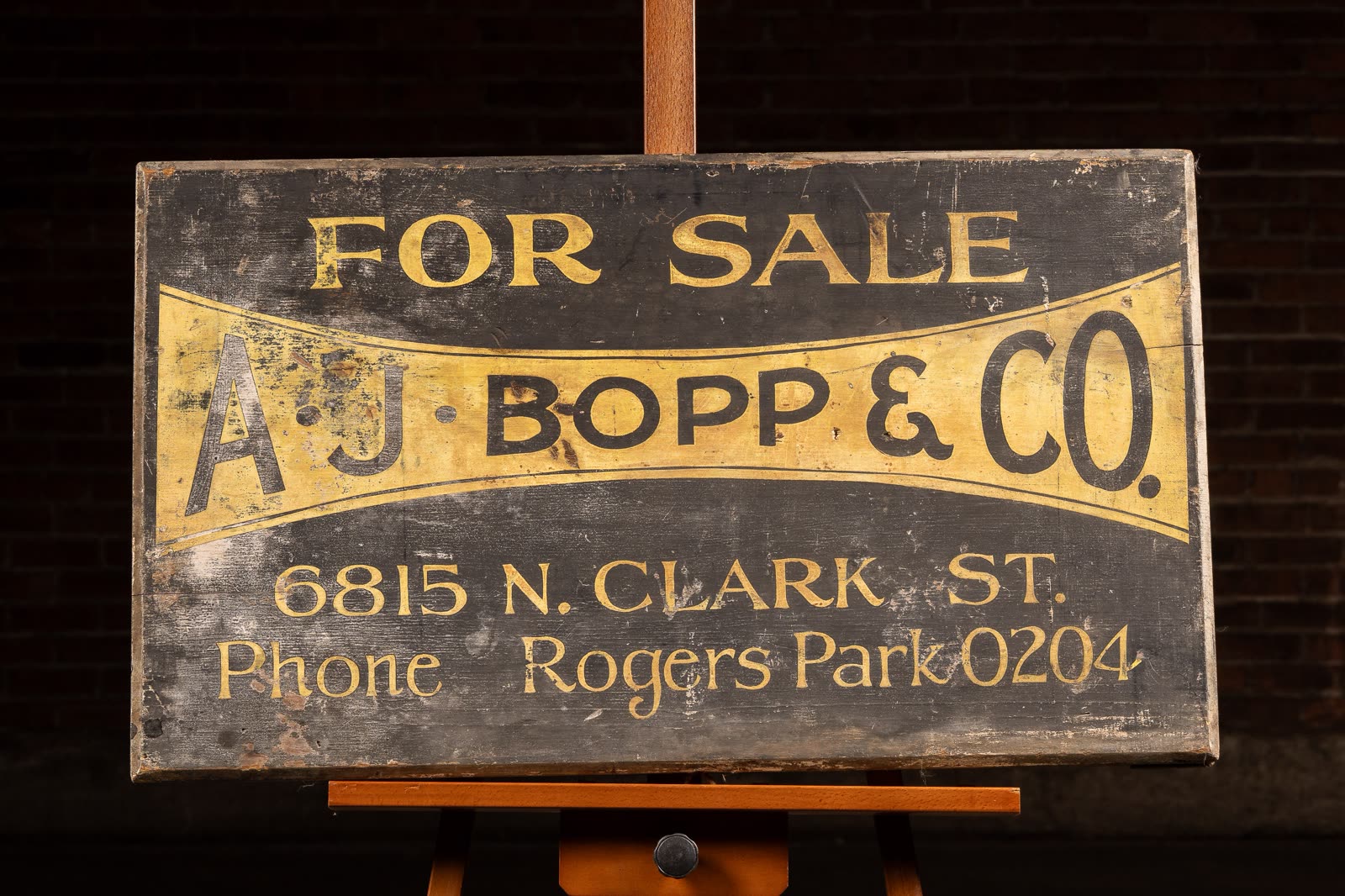
A painted wood trade sign from Rogers Park, Chicago, c. 1920s. There is exactly one of it, which is the whole difficulty: nothing here has a duplicate to fall back on. — Industrial Artifacts
Teresa Allen runs financials, consignor management and auction management, and, in her words, frequently gets pulled in “to help facilitate retail sales, locate items, assist others with managing their workflow, and more.”
The reason inventory matters so much here is structural, and Teresa puts it plainly.
“When an item sells, it’s not like a typical retail setting where folks bring the items they want to purchase up to a store counter. In that case, you don’t have to locate the item. The customer has done that for you! By contrast, our sales are nearly all conducted online, meaning when something sells, we have to locate it before it can ship out.”
— Teresa Allen
Every sale ends with a person walking into a building to find one specific object. That is a hospital looking for one infusion pump, or a university looking for one camera body, except there are ten thousand of them and no two are the same.
Four hundred lots, off the floor, once a month
Once a month, Rock Auction Gallery closes an auction and three people go and physically retrieve between three hundred and sixty and four hundred lots.
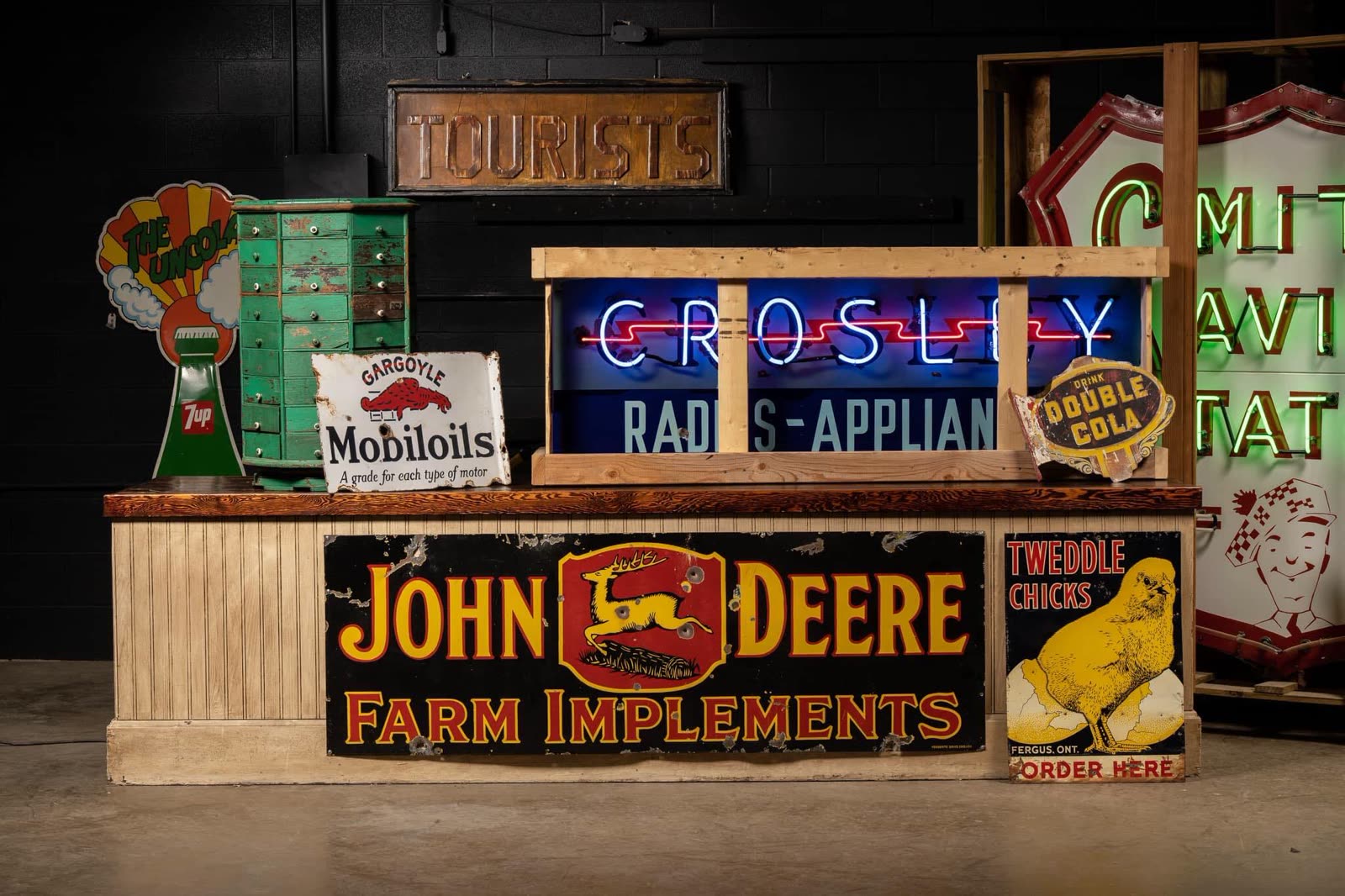
A fraction of one auction. Every piece in this frame is a separate record with its own SKU, its own consignor and its own location. — Industrial Artifacts
The geography matters.
“Our warehouse can be divided into six rooms, with bays located within each room. Most of our auction lots are housed on rolling tables with casters that we purpose built for moving inventory efficiently. The tables are also locations in Shelf, Table A through Z, then repeating with Table A2, B2, and so on. When an item is photographed, it is scanned into a table and remains there until the auction closes.”
— Al Ferris
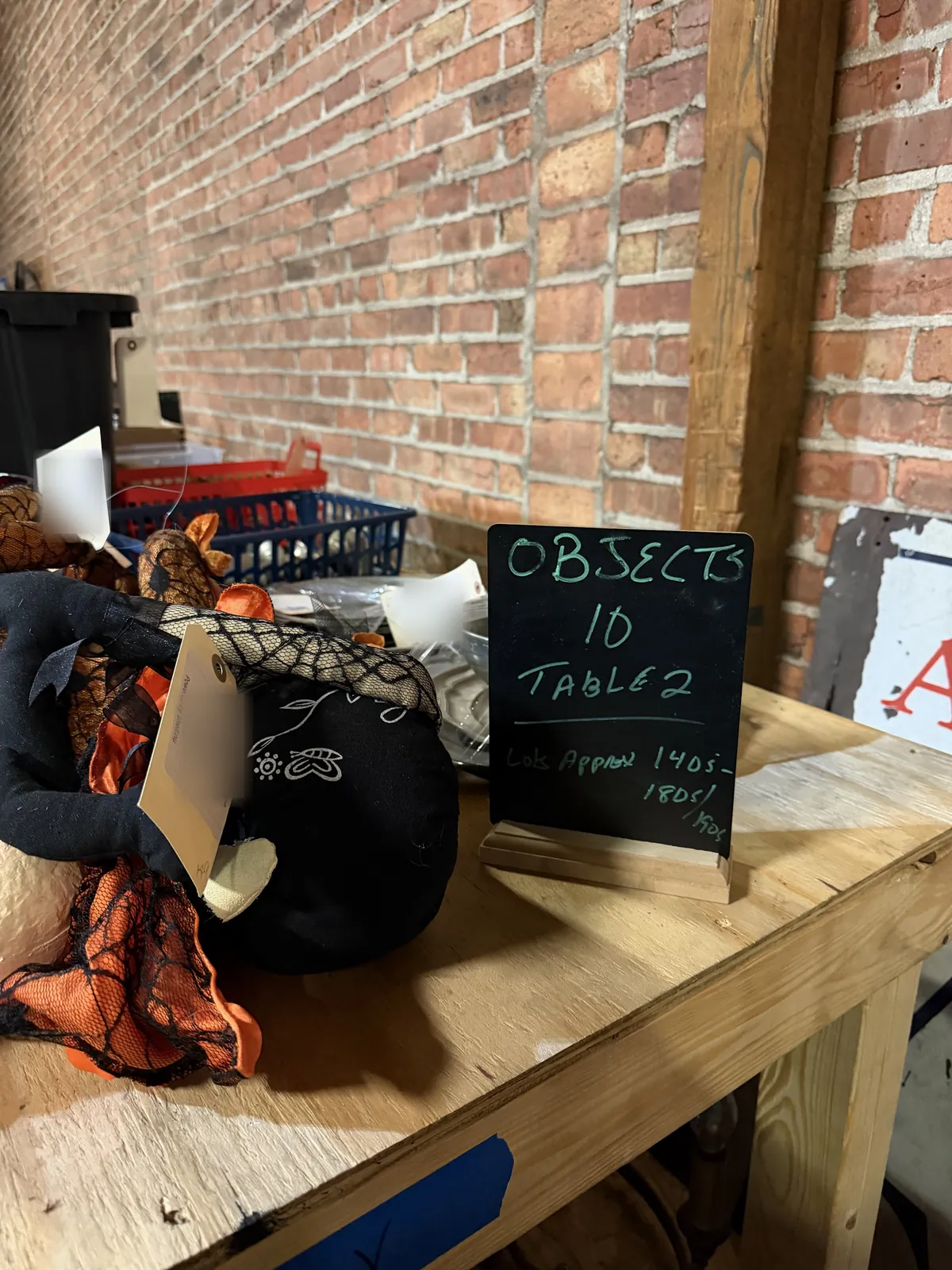
Table 2 of the Objects 10 auction. The board says which lots belong on it, and the label on each lot says exactly which one you are holding. QR codes blurred. — Industrial Artifacts
So the floor physically reconfigures itself for the close. The room has a north bank of bays, a south bank, and a main thoroughfare up the centre. The tables that have held each lot since the day it was photographed get rolled into that thoroughfare end to end, and the team walks it, invoice by invoice.
“I begin by pulling all the items on an invoice. When they’re all pulled, I double check that I’ve pulled the correct lots. Then, I use the bulk location update feature on Shelf to scan each item on the invoice into the Sold location. Then I move onto the next invoice.”
— Teresa Allen
Every employee gets a two-question checklist stapled to each auction invoice: did you scan the items into Sold, and is everything on the invoice accounted for.
Not everything is on a table. Furniture and larger pieces live in the bays or elsewhere in the building, and Al is honest about what that costs.
“It’s up to the warehousing team and the auction fulfillment team to communicate and pull forward any furniture that has sold in the auction, especially so if a forklift needs to be involved as this will cause temporary congestion in the thoroughfare that gets felt all over the warehouse.”
— Al Ferris
And when a lot is not where it should be, the SKU decides the argument rather than the shop floor.
“In some cases, we may not be able to easily find an item on an auction cart. When that happens, we look up the SKU in Shelf to see where Shelf says the item is stored. Often, what we find is that the item was for some reason or other stored in a different location in our warehouse. So we make note of that item’s location and pull it to add it to the auction order.”
— Teresa Allen
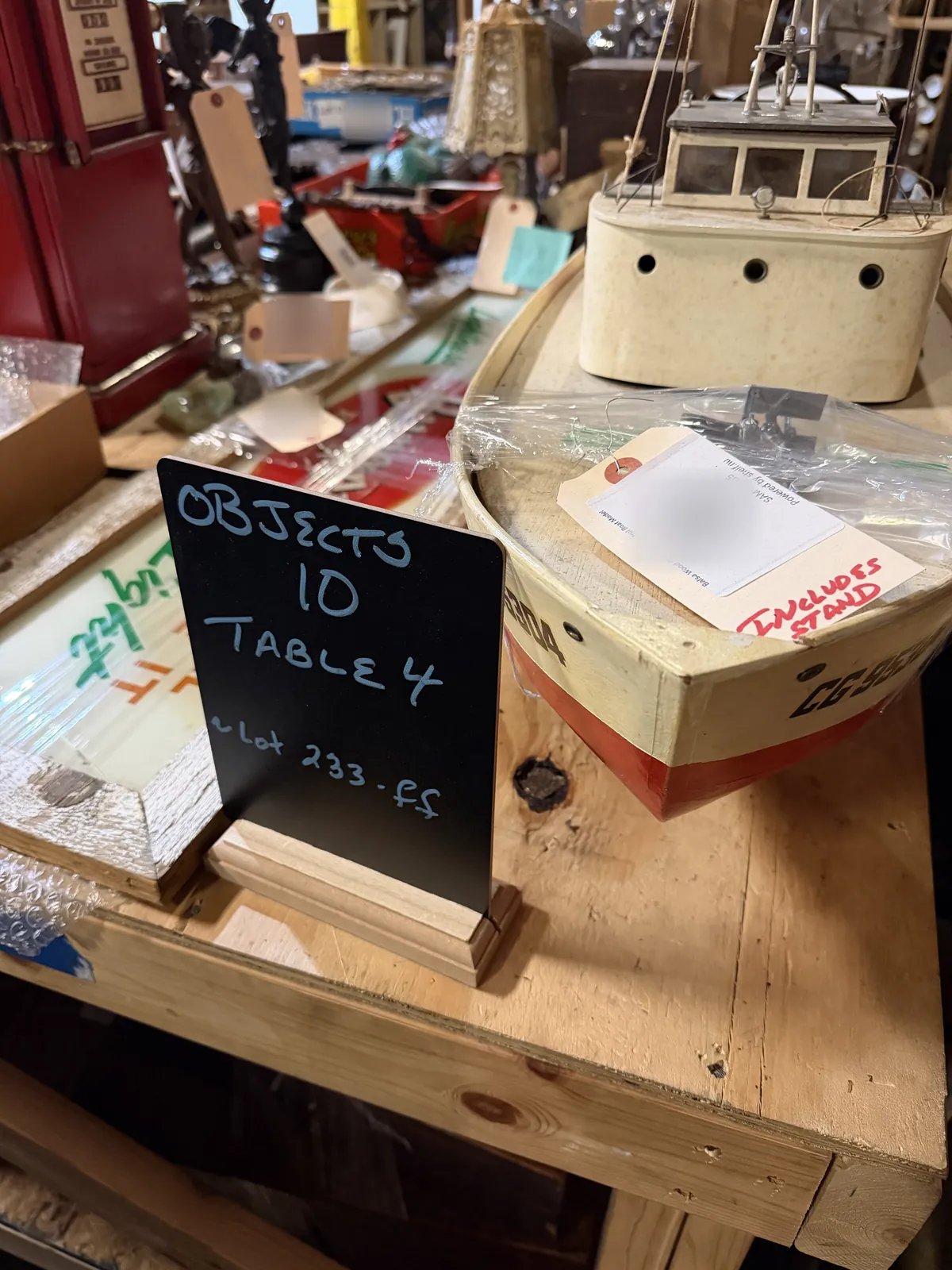
Table 4 picks up at lot 233. Every lot on it carries its own label, so a piece that is not where the board says is one SKU lookup away. QR codes blurred. — Industrial Artifacts
Getting an object into the system in the first place
The close only works because intake is disciplined, and intake is a batch operation rather than a data-entry chore.
A photographer lines up twenty to thirty items, shoots them, and records name, condition, dimensions and consignor onto a spreadsheet as they go. That spreadsheet gets bulk-imported, which does three jobs at once: it creates the records, it assigns each one a sequential ID, and it sets the location, because the rolling carts and tables are locations and the location is just another column in the import.
“The bulk import option allows us to do this step all in one go rather than having to individually add the many items we process in a day. The catalogers can then print the SKU tags and physically attach them to the respective lots.”
— Teresa Allen
Consignment is handled with tags. If everything on a cart was consigned by Teresa, the whole batch is tagged Teresa Allen, and months later the question of whose piece sold is a filter rather than a conversation.
Labels print with a readable ID alongside the scannable code, which is why a SKU on a printed auction invoice is enough for someone to match a lot by eye without reaching for a phone.
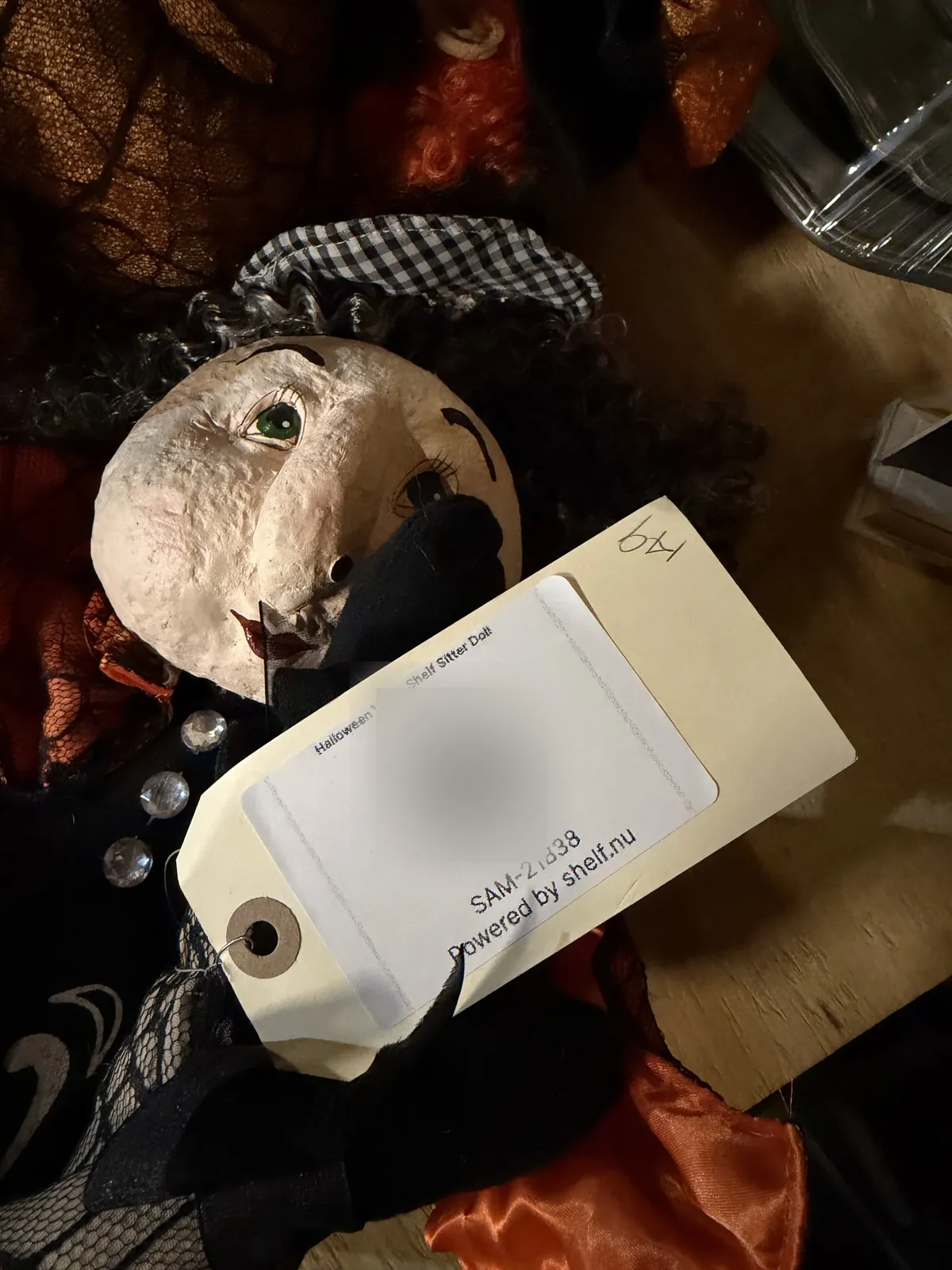
The label on a single lot: the item name, the scannable code, and the SAM ID printed in plain text underneath. QR code blurred. — Industrial Artifacts
Forty things sold over a weekend
Around forty items sell over a weekend across the retail channels, and the shipping coordinator has to go and get every one of them.
“Our shipping coordinator typically will look at our listing aggregator every day to see what has sold since the last day he worked. Each sold listing has a unique SAM-ID from Shelf noted as a SKU. The shipper will then look up the SKUs in Shelf, make note of where sold items are located, and then pull the pieces from their various storage locations in our warehouse.”
— Teresa Allen
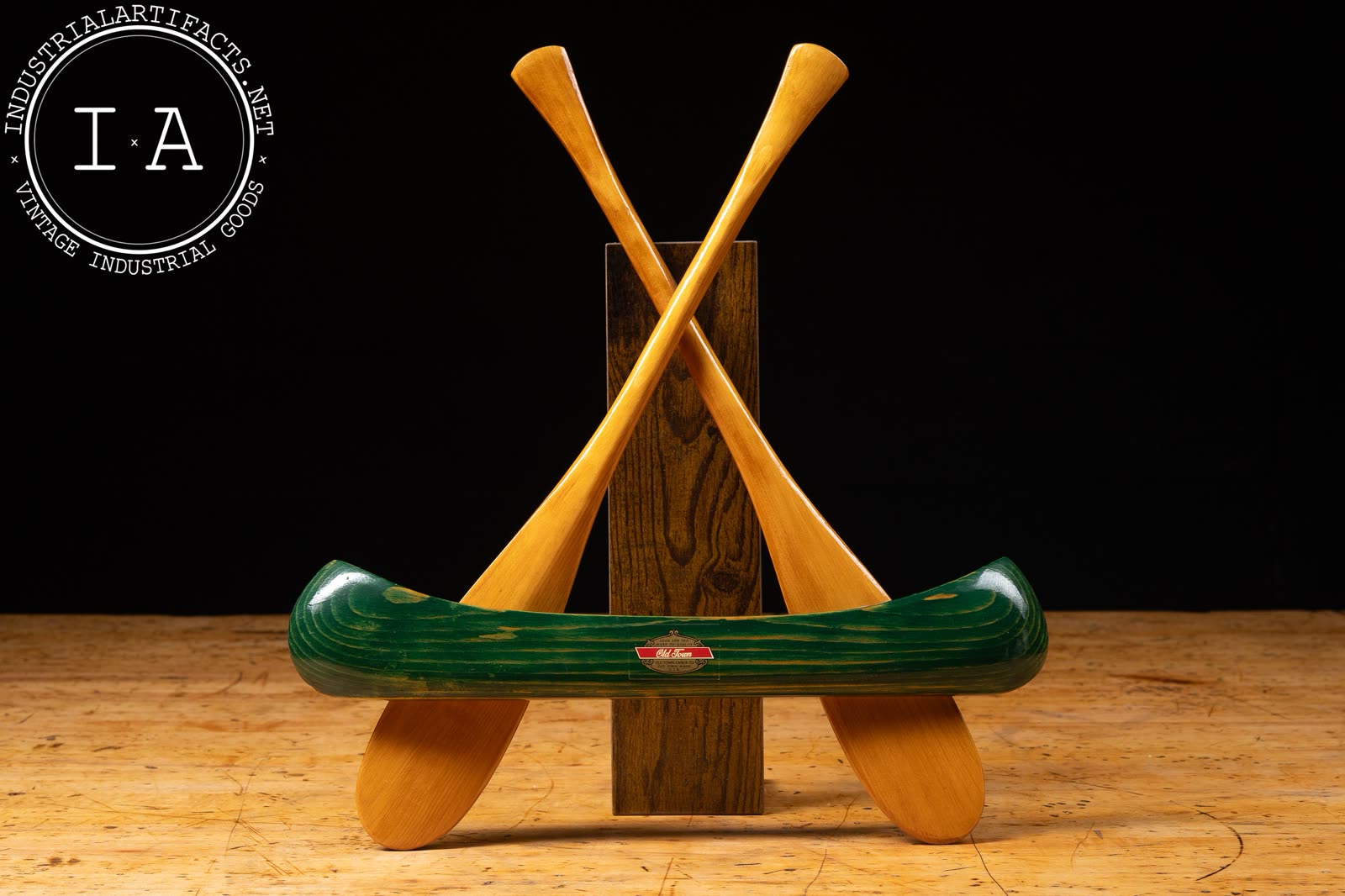
A salesman’s sample canoe — the kind of small, high-value object that is trivial to move and almost impossible to find again by memory. — Industrial Artifacts
Al describes the same morning from the floor: an associate takes a plastic tote, gathers the smalls, and brings them to the shipping area to be packed and scanned into Sold. Freight items go to the woodshop at the back to be cleaned and prepped, then to the freight staging area.
His summary of how that used to go is the sharpest before-and-after in the whole conversation.
“This process used to be much more loose. Simply finding something that sold was challenging. It was kind of a part time job.”
Asked to put a figure on it, he would not invent one. “Any number I put on it would just be pulled from thin air,” he wrote. What he would say is that before they had an inventory system of any kind, “hours per week were spent finding inventory,” and that it was “a major barrier to our growth.”
When something is genuinely missing
It still happens, and what they do about it is the most instructive thing in these answers, because it is a technique rather than a feature.
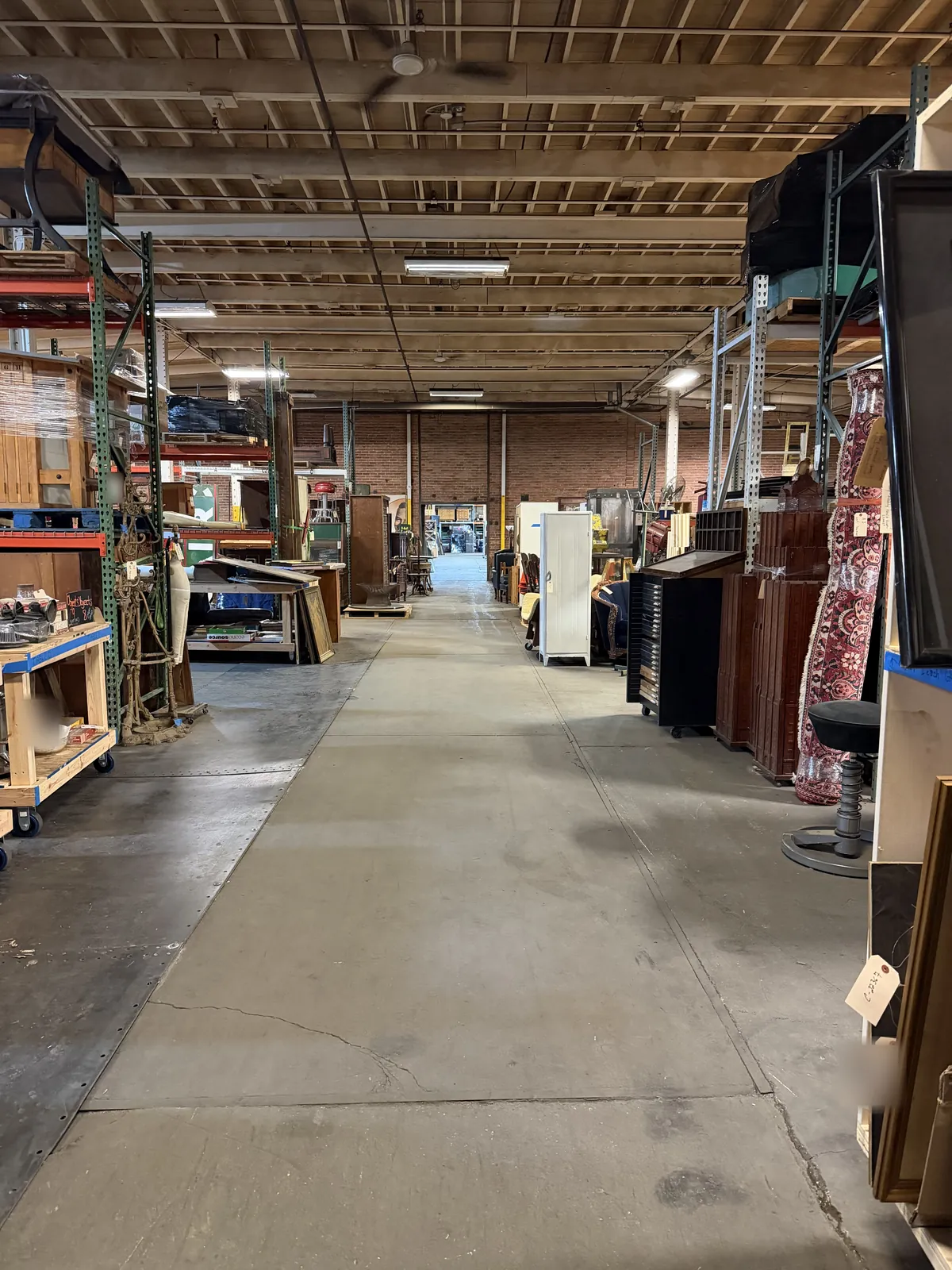
One aisle of one room. An object with no recorded location could be anywhere in a space like this, which is why the neighbouring SAM IDs matter. — Industrial Artifacts
First they check the asset’s last recorded activity. If it is recent, someone in the shop probably still remembers touching it. Then they triangulate on the neighbours.
“Suppose we’re looking for an item with SAM-ID 18500 and it doesn’t have a location listed in Shelf. We then take a look at SKUs in the 18490–18499 range as well as in the 18501–18510 range to see if we can piece together where the item may be located. Oftentimes, when we’re moving items from being processed to storage, items processed around the same time wind up in similar locations. This method of tracking down items tends to work a lot of the time when things go missing.”
— Teresa Allen
Sequential IDs turn out to encode something nobody designed them to encode. Things numbered near each other were handled near each other, and are therefore probably shelved near each other. Searching the ID range around a missing item recovers pieces that would otherwise be written off — and it costs nothing to try in any system that numbers assets in the order they are catalogued.
Al is equally candid that the system is not self-enforcing.
“In the past items have unfortunately not been scanned into ‘Sold’ all of the time. This was especially prevalent before the dedicated Shelf app was released and scanning was much harder. Warehouse maintenance is an ongoing conversation at our shop, and we do still find items that we have sold at auction still lingering around in other Shelf locations.”
— Al Ferris
Ten people, no training project
Ten people are in Shelf every week, and Teresa says every staff member uses it nearly daily, to add assets, locate them, update locations and check which consignor a piece belongs to.
“To my knowledge, everyone has had a relatively easy time getting used to using Shelf. We used to use a similar IMS in the past, so for employees who have been with us for some time, it was an easy transition. But even our new employees seem to be able to navigate it with ease.”
— Teresa Allen
Eight thousand eight hundred and sixty items
Their Sortly contract was expiring, and 8,860 items had to move.
What came out of the old export looked like any business that has been running for years: barcodes duplicated where one item sat in two places, a stray prefix corrupting a whole run of codes traced back to an ageing phone, and a handful of legacy code formats from an experiment nobody remembered fondly. Teresa cleaned the sheet herself.
“I did the whole sheet rather than just the first 1,000 rows since it was easy enough to do in one sitting.”
— Teresa Allen
Everything landed inside two weeks, and they kept the barcodes already stuck to the shelves rather than re-labelling a warehouse.
How they run it in Shelf
Nothing here is bespoke. Every part of the workflow above is a standard feature, and this is the whole map of it.
| What they do | In Shelf |
|---|---|
| Six rooms, banks of bays, bins, and ~50 rolling tables are all addressable places | Location tracking, nested with sublocations so a bin sits inside a bay inside a room |
| A cataloger shoots 20–30 items and imports the whole batch from one spreadsheet, location column included | CSV import |
| At the auction close, each invoice is scanned item by item into the Sold location | Batch scanning actions, or the batch actions menu from the asset list |
| Every listing carries a SKU that ties the storefront back to the object | The sequential SAM ID, printed readable next to the scannable code |
| Tags mark which consignor a piece belongs to, so “whose was it?” is a filter | Tags |
| Cataloged lots get a printed label attached on the spot | Printed QR labels |
| A shipper looks up a SKU and gets a location | Asset search |
| When something is missing, they check what happened to it last | The activity trail on the asset page |
| Two buildings, one system | Multi-location asset tracking |
What they would tell you
Teresa draws the line at the point where a spreadsheet stops working, and she is fair about where that line sits.
“For some businesses with limited assets and storage space, using a spreadsheet may work just fine. So long as it’s regularly updated and items don’t move once they’re put in a storage location. But for businesses like ours, where we have more than 10,000 assets and MANY storage locations, using a true IMS is a necessity.”
— Teresa Allen
“Not only do we have lots of assets and storage areas, but we tend to have to move pieces with some regularity. So having the ability to quickly scan items into a new location using your phone saves a lot of time and headache compared to having to update items on a spreadsheet every time an item is moved.”
— Teresa Allen
Al’s answer to the same question was one word.
“Don’t.”
“Jokes aside, using a dedicated IMS will save you time and money in ways you can’t even imagine before using one. Running inventory out of a spreadsheet makes compound, hydra-like problems where even if you solve for one issue more tend to pop up in its place.”
— Al Ferris
“If I were starting again, I’d find a dedicated IMS much sooner.”
Ten thousand things, and you can find any of them
If every sale in your business starts with someone walking into a building to look for one specific object, Shelf is built for exactly that.